Start here: choose your founder pathway

BY THE END OF THIS LESSON
Choose a product-development pathway based on capital, technical experience, time to market, risk, and control.
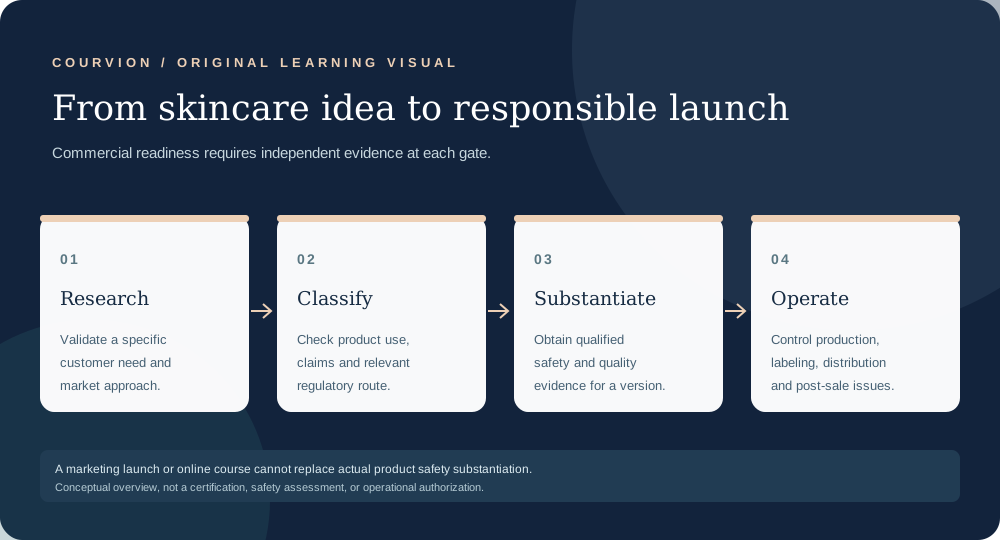
Read the complete diagram transcript
Stage 1 — Research: Collect evidence of customer demand and compare realistic product-development pathways.
Stage 2 — Classify: Check the cosmetic product's intended use, labeling, claims and applicable regulatory category.
Stage 3 — Substantiate: Arrange qualified assessment of the exact formula and packaging, including appropriate safety and quality evidence before sales.
Stage 4 — Operate: Control manufacturing, lot traceability, labeling, distribution, complaints and post-market responsibilities.
Editorial scope: conceptual introduction only. No video, voiceover, clinical skills certification or cosmetic product approval is represented by this diagram.
Core concept
Four common pathways are independent formulation, an existing private-label formula, a custom formulation by a contract manufacturer, and a hybrid. A product idea does not determine the best route: the founder's ability to document safety, source qualified manufacturing and support customer service does. Private label can shorten development while limiting differentiation; custom work can improve distinctiveness but typically requires larger commitments and formal agreements.
Apply the concept
Create a decision matrix with startup cash, minimum order quantities, ownership of formula and artwork, expected lead time, testing responsibilities, warranty terms, and market positioning. Score each pathway using evidence and record assumptions that still require supplier confirmation.
Professional decision-making
Separate commercial control from legal responsibility. Even if another company manufactures the product, branding and labeling can make the founder a responsible person under applicable U.S. cosmetic law. Never interpret a supplier's marketing promise as proof of safety.
In practice
- List your real constraints: budget, time per week, technical skills and how soon you need revenue.
- Compare the four routes (self-formulation, private label, custom contract manufacturing, hybrid) against those constraints.
- Ask every supplier for documents you can check, such as specifications, lot records and testing summaries.
- Be wary of claims like 'FDA certified' or 'FDA approved' for cosmetics. FDA does not approve cosmetic products before they are sold.
- Pick one route for your first product and write down why, so you can revisit the choice later.
Case study
A founder has $2,000, no formulation training and wants to release a face cream in four weeks. A supplier advertises 'FDA certified' bulk creams.
Think about what you would do, then show the recommended response
A professional response pauses the promised launch, asks for ingredients, traceability, testing and compliance records, checks whether 'FDA certified' is misleading, and re-evaluates budget and timing.
Your practice task
One-page pathway recommendation plus a comparison matrix for three plausible suppliers or methods. Check yourself: Decision uses verified constraints rather than enthusiasm. Named owner for safety, quality, labeling and complaints. Unanswered evidence requests and a stop/go date are identified.
Common misconception
Fast packaging and a low minimum order are not substitutes for substantiated product safety.
Check yourself
- Does FDA approve cosmetic products before sale?
- Which route usually gets a first product to market fastest?
- What should you ask a supplier for before you buy?
Show the answers
1) No. Most cosmetics are not pre-approved, but the brand is still responsible for safety and correct labeling. 2) Often private label, because the formula already exists, but you still need to verify safety and documents. 3) Specifications, lot or batch records, testing information and their change-notification policy.
Sources
- Plan Your Business: Market Research and Competition (opens in a new tab) U.S. Small Business Administration
- Write Your Business Plan (opens in a new tab) U.S. Small Business Administration
Checked against the official sources listed below on November 9, 2026. Educational only: not medical, legal or regulatory advice, state-approved training, or certification.